
Just tap the title below to view the full article PDF. ⬇️
acne keloidalis nuchae treatment article pdf
Bumps at the Back of the Neck That Won’t Go Away? It Might Be Acne Keloidalis Nuchae
Despite the name, acne keloidalis nuchae (AKN) has nothing to do with acne — and it isn’t really made of keloid tissue either. It’s a chronic, often frustrating condition where small, firm bumps develop at the nape of the neck and can, over years, grow into larger scar-like plaques. Patients often come to us after trying multiple creams, injections, and even laser sessions elsewhere with only partial or temporary improvement. At Shivani Skin Care & Cosmetic Clinic, we developed and published a combined treatment approach that’s given our patients consistently better, more lasting results.
What Is Acne Keloidalis Nuchae?
AKN shows up as small, firm bumps — sometimes scabby, sometimes pus-filled — around hair follicles at the back of the scalp and neck. Left untreated, ongoing inflammation causes these bumps to merge into larger, raised, scar-like plaques and nodules. It’s far more common in men than women, and tends to occur more often in people with curly or tightly coiled hair.
What’s actually happening beneath the skin is a chronic inflammatory reaction: damaged hair follicles release their hair shaft into the surrounding skin, and because the upper part of the follicle is affected, the body can’t fully clear that hair shaft away. This drives a continuous cycle of inflammation and scarring — which is exactly why AKN is so notoriously difficult to treat once it’s established, and why it tends to keep coming back after treatments that only address the surface.
Why Standard Treatments Often Fall Short
Early, mild AKN often responds to simpler measures — avoiding friction from clothing and helmets, keeping the area clean, and topical or injected steroids alongside retinoids or antibiotics to calm inflammation. But once the condition has progressed to firm plaques and nodules, medical treatment alone usually isn’t enough, and surgery becomes the more realistic option.
The trouble is, the traditional surgical routes each come with real downsides:
- Surgical excision (with or without skin grafting) can be effective, but usually involves 2–3 weeks of downtime, frequent dressing changes, and a real risk of infection or relapse.
- Electrosurgery and dermabrasion are less invasive but are more prone to lesions returning or scarring hypertrophically over time.
- Laser treatment or steroid injections used alone each address only part of the problem — the visible bulk of tissue, or the underlying inflammation — but not both together, which is likely why relapse is so common.
Our Approach: Combining Two Tools in One Sitting
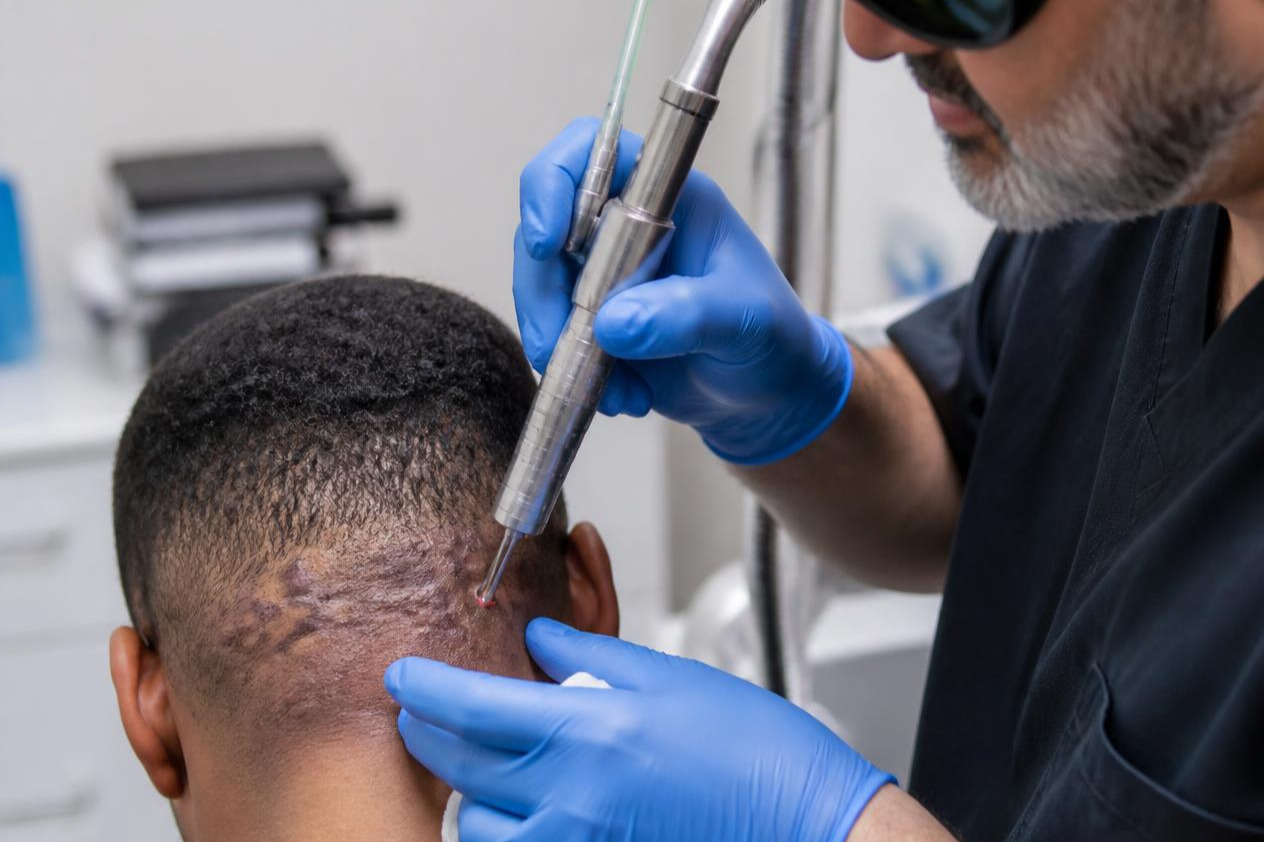
Rather than choosing between laser ablation and steroid injection, we combined both — carbon dioxide (CO₂) laser ablation immediately followed by an intralesional triamcinolone (steroid) injection, delivered in the very same outpatient sitting.
How the procedure works
- Preparation — the area is trimmed and prepped, and the lesions are numbed with local anesthesia.
- CO₂ laser ablation — using a focused, continuous ablative setting, the laser beam is directed along the line of the hair follicle to reach the fibrotic tissue underneath, vaporizing the affected tissue in a controlled, circular motion.
- Intralesional steroid injection — triamcinolone acetonide is then injected directly at the base of each treated lesion, right after ablation, to control the underlying inflammatory process that laser alone can’t fully address.
- Aftercare — a short course of antibiotics and pain relief is prescribed, with follow-up checks at 1, 3, and 8 weeks to assess healing.
- Repeat sessions — most patients need about three sessions, spaced 8 weeks apart, though larger, coalesced lesions may need a fourth.
The Results
In our case series of long-standing, treatment-resistant AKN patients — many of whom had already tried steroid injections, retinoids, and cryotherapy without lasting success — the vast majority saw more than 90% resolution of their lesions within three sessions. Just as importantly, on close follow-up over six months after the final treatment, none of the patients experienced a recurrence.
Because this is an outpatient procedure without the extended wound care that excision requires, downtime was minimal — a meaningful advantage over surgical options that can keep patients out of normal activity for weeks.
Why Combining Rather Than Choosing Matters
The logic behind pairing these two treatments together is straightforward once you understand what’s actually driving AKN: the laser reduces the physical bulk of the fibrotic, keloid-like tissue, while the steroid injection tackles the ongoing granulomatous inflammation that keeps rebuilding it. Treating only one half of that equation — as most conventional approaches do — leaves the door open for lesions to return. Addressing both, in the same sitting, appears to close that door far more effectively.
The Takeaway
If you’ve been dealing with persistent, painful, or unsightly bumps at the back of your neck that haven’t responded to creams or injections alone, it may be worth exploring a combined treatment approach rather than another round of the same single modality. We’d be happy to assess your case and discuss whether this technique is right for you