
Just tap the title below to view the full article PDF. ⬇️
follicular unit extraction on segmental vitiligo article pdf
Treating Genital Vitiligo: Why Hair Follicles Can Succeed Where Other Techniques Struggle
Vitiligo can appear anywhere on the body, but when it affects the genital region, patients often find it one of the hardest forms to talk about — and, for a long time, one of the harder forms to treat well. At Shivani Skin Care & Cosmetic Clinic, we’ve had success using a technique borrowed from hair transplantation, follicular unit extraction (FUE), to treat stable genital vitiligo, and published our findings in the Journal of Cutaneous and Aesthetic Surgery.
Why Genital Vitiligo Is Especially Difficult to Treat
Vitiligo happens when the body’s pigment-producing cells (melanocytes) are progressively lost, leaving patches of depigmented skin. It’s an autoimmune condition, and beyond the visible changes to the skin, it can have a real psychological and emotional impact — something that’s magnified when the affected area is one patients feel especially private about.
The genital area presents some unique practical challenges for surgical treatment:
- The pubic region has a lot of pre-existing hair, which can interfere with graft placement and healing.
- The scrotal skin, by contrast, has only sparse, fine hair and different texture and mobility than skin elsewhere on the body.
- Movement restriction and keeping a dressing in place over this area after surgery is genuinely difficult, which can compromise how well conventional grafts take.
Standard surgical options for vitiligo — like miniature punch grafting or non-cultured melanocyte suspension — are well-documented and effective in many areas of the body, but they typically require patients to restrict movement for at least a week for the graft to take properly. In a region where that’s hard to enforce, results can suffer, and there’s also a chance that the melanocytes get inadvertently lifted away as hair grows back underneath the dressing.
Our Approach: Follicular Unit Extraction (FUE)
FUE is a technique most people associate with hair transplantation, but it turns out to be an excellent solution for genital vitiligo too — for a very specific biological reason. Hair follicles carry their own reserve of melanocytes, tucked away in the outer root sheath, and these follicular melanocytes tend to be more resistant to the vitiligo process than the melanocytes in ordinary skin. That makes hair follicles a reliable, self-contained source of new pigment cells.
How the procedure works
- Preparation — both the donor area (typically the back of the scalp) and the recipient area are cleaned and prepped.
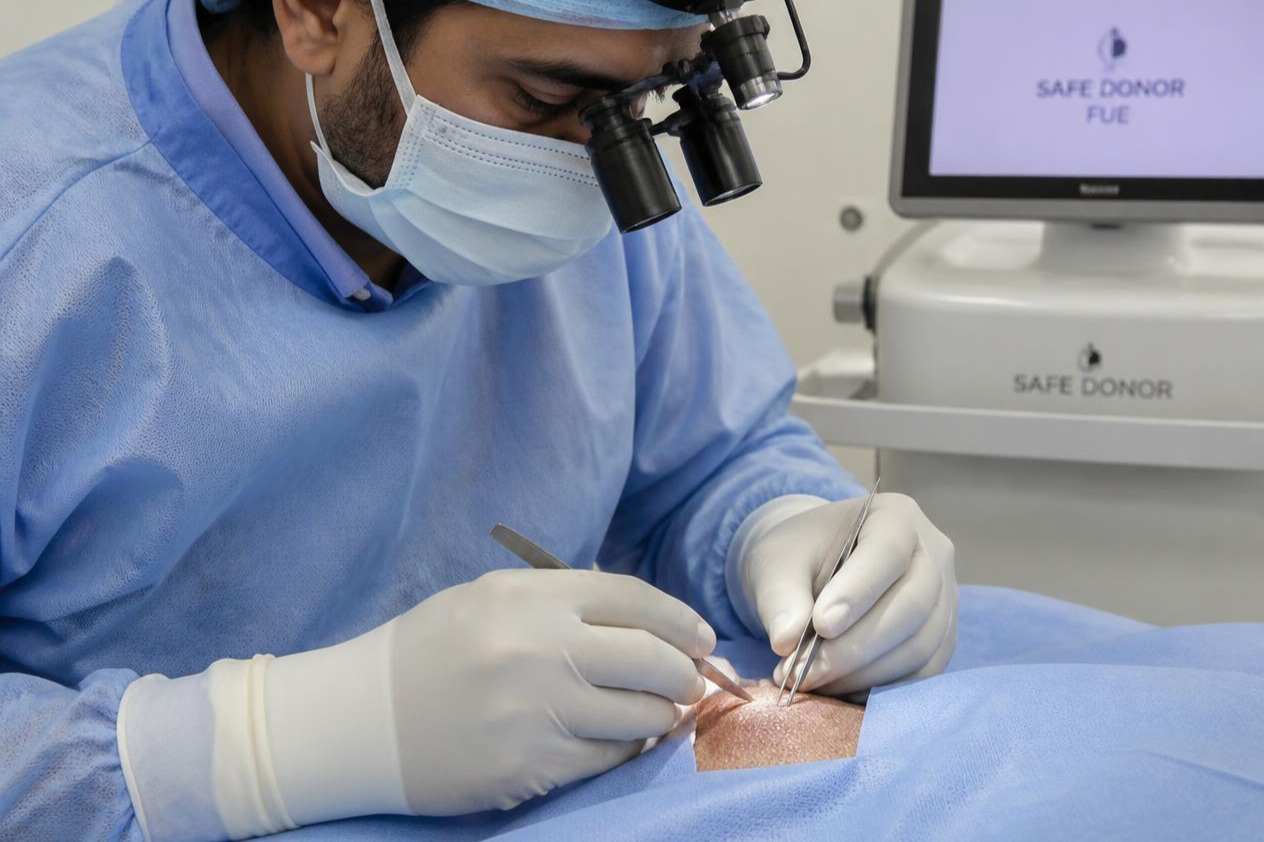
- Harvesting — individual hair follicular units are extracted from the donor site using a small micromotor punch, under local anesthesia, and kept in a cold saline solution until they’re transplanted.
- Preparing the recipient site — tiny slits are made in the depigmented skin to receive the grafts.
- Transplanting — the follicular units are carefully placed into the recipient site using fine forceps.
- Securing the graft — rather than a bulky dressing, the grafts are fixed in place with surgical glue. This is a key advantage in this particular region: it improves patient comfort and compliance and doesn’t rely on the patient staying still for a week, which simply isn’t practical here.
- Recovery — a short course of oral antibiotics is given, and topical and light-based therapies are introduced a couple of weeks later to support ongoing repigmentation.
What Results Can Look Like
In our experience, early perifollicular repigmentation can be seen within about 4 weeks, with more complete pigmentation developing progressively over the following weeks to months as the transplanted follicles establish new colour around themselves. One limitation worth being upfront about: leukotrichia (white hair within the affected area) does not reliably respond to this or most other vitiligo treatments, so expectations there should be set accordingly.
Why This Technique Has an Edge in This Region
Because the donor site is the back of the scalp — an area that heals exceptionally well and is easily concealed — this approach avoids the visible scarring and pigmentation changes that can sometimes occur at the donor site with other grafting methods. It also tends to produce a more natural, even colour match and less of the “cobblestone” texture that can occur with punch grafting, since hair follicles simply carry a richer concentration of melanocytes than a comparable patch of ordinary skin.
The Takeaway
Genital vitiligo is a genuinely difficult area to treat surgically, largely because of the practical constraints the region itself imposes — hair, sensitive skin, and the difficulty of keeping a dressing in place. Follicular unit extraction sidesteps those specific obstacles while tapping into a biologically favourable source of pigment cells, making it a technique worth discussing if you’re dealing with stable vitiligo in this area and haven’t found success with medical treatment alone.
If this is something you’ve been living with quietly, know that effective, discreet treatment options do exist — we’re happy to talk you through whether this approach is right for you.