
Just tap the title below to view the full article PDF. ⬇️
Elliptical excision against RSTL article pdf
Do Surgical Scars Really Depend on Which Direction the Incision Runs? Here’s What Our Research Found
If you’ve ever needed a mole, cyst, scar, or skin growth surgically removed from your face, you may have heard your surgeon mention “relaxed skin tension lines,” or RSTL. For decades, these natural lines — the paths along which skin has the least tension — have been treated as the gold standard for planning facial incisions, on the theory that cutting along them produces the least noticeable scars.
But what happens when a lesion simply can’t be removed along these lines — because of its shape, size, or location? Does the scar automatically turn out worse?
At Shivani Skin Care & Cosmetic Clinic, we decided to put this question to the test.
The Study
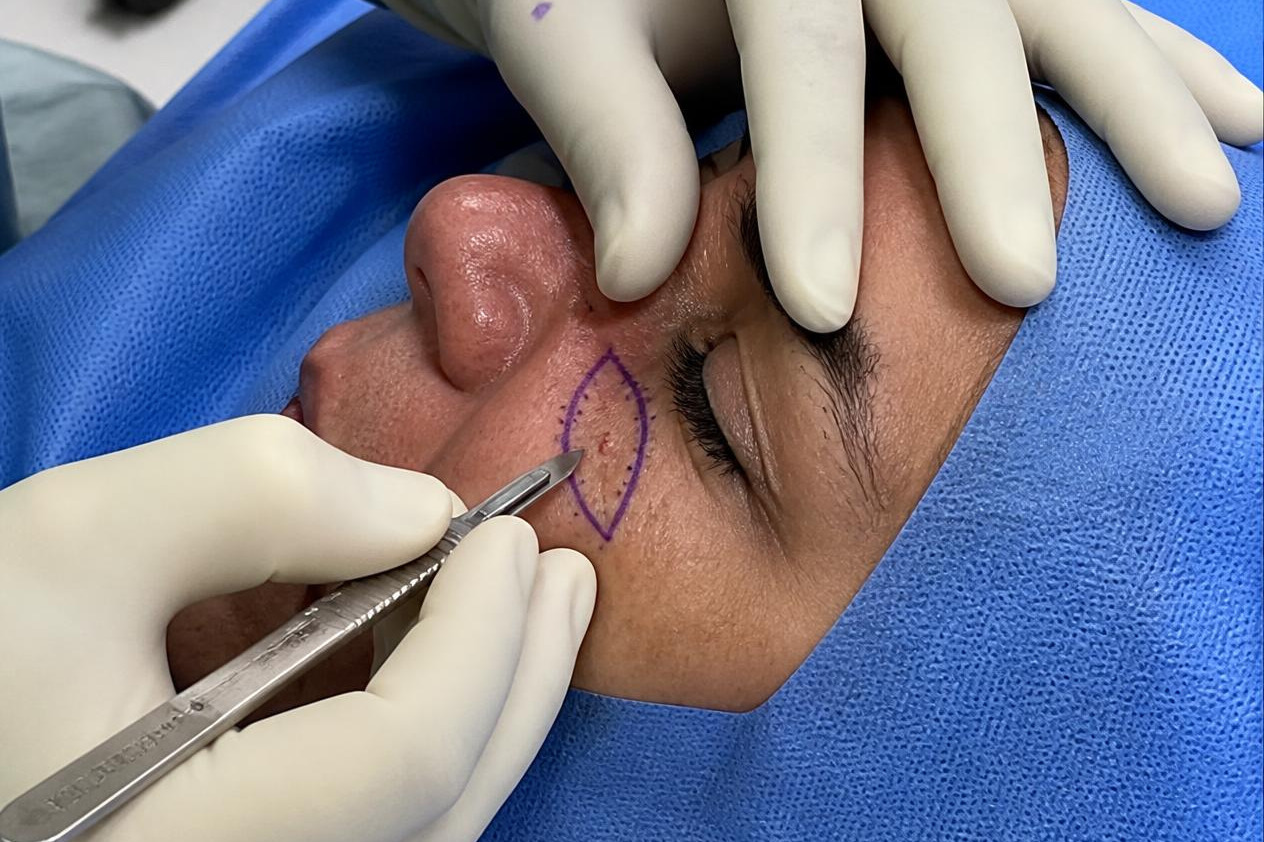
We conducted a retrospective, randomized comparative study of 100 patients who underwent elliptical excision surgery on the face — a common technique used to remove moles, cysts, scars, and other skin lesions in an oval (elliptical) shape, allowing the wound edges to be brought together cleanly.
Patients were split into two groups:
- Group A — excision planned against the RSTL
- Group B — excision planned along the RSTL
Six months after surgery, two independent observers scored each patient’s scar using the modified Vancouver Scar Scale (VSS), a standard tool for objectively grading scar appearance.
What We Found
The results were genuinely reassuring for patients who need excisions in areas where following the RSTL isn’t practical:
- There was no meaningful difference in scar quality between the two groups. The average scar score was 2.1 for excisions against RSTL and 1.9 for those along RSTL — a difference that was not statistically significant.
- 90% of all patients, regardless of group, ended up with a favorably low scar score after 6 months.
- Complications were uncommon and similar between groups — about 11% of patients overall experienced minor issues such as infection, wound gaping, or scar irregularity, with no meaningful difference between the two techniques.
- The most common reasons for excision in our patients were compound nevi (moles) and post-traumatic scars, and lesion location often dictated whether RSTL could realistically be followed — for example, forehead lesions were more often excised against RSTL, while cheek lesions were more often excised along it.
Why This Matters
In real-world practice, a lesion’s shape, size, and orientation don’t always cooperate with the “ideal” tension lines. Traditionally, surgeons faced a difficult choice in these situations: force the incision along the RSTL (even if it meant a less efficient excision or more tissue removal), or accept the assumption that going against the RSTL would compromise the final scar.
Our findings suggest this trade-off may not be necessary. Excisions performed against RSTL produced equally good results — provided the wound was properly supported. In our protocol, this meant closing every wound in two layers: a supportive subcutaneous (under-the-skin) layer of stitches, followed by a precise skin-level closure. This technique appears to compensate for any added tension from an incision that doesn’t run along the “ideal” lines.
This lines up with a related concept known as Biodynamic Excisional Skin Tension (BEST) lines — an alternative framework suggesting that true wound tension doesn’t always align with the classic RSTL map, especially in areas like the forehead.
What This Means for You
If you need a lesion removed from your face — whether it’s a mole, a post-traumatic scar, a cyst, or another growth — the direction of the incision relative to RSTL is only one part of the picture. What matters just as much is:
- Careful surgical planning tailored to the specific lesion
- Proper wound closure technique, especially adequate subcutaneous support
- Experienced aftercare and follow-up
Rather than forcing every excision into a rigid RSTL-only approach — which can sometimes mean sacrificing more healthy tissue than necessary — a thoughtful, technique-driven approach can achieve excellent cosmetic outcomes even when the “ideal” orientation isn’t possible.
A Word From Our Clinic
This research reflects our broader philosophy at Shivani Skin Care & Cosmetic Clinic: surgical decisions should be guided by what actually produces the best outcome for each patient’s unique lesion, not just textbook rules. If you have a mole, scar, or skin growth you’re considering having removed, we’d be glad to assess it and walk you through the safest, most cosmetically favorable approach for your specific case.