
Just tap the title below to view the full article PDF. ⬇️
surgical management of vitiligo article pdf
When Creams and Light Therapy Aren’t Enough: Surgical Treatment for Vitiligo
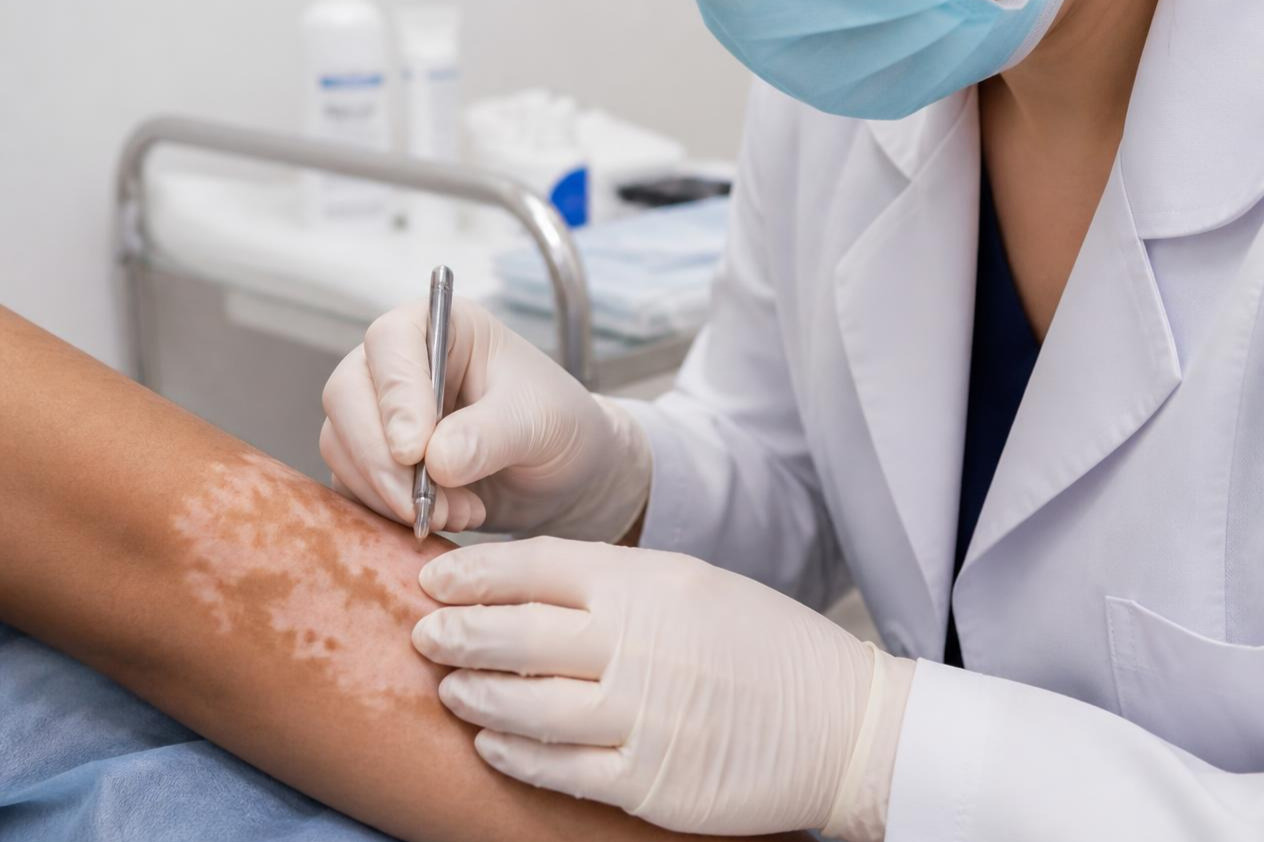
Vitiligo is one of the most emotionally difficult skin conditions to live with. It isn’t dangerous, but the visible loss of skin colour — especially on the face, hands, or other exposed areas — can take a real toll on confidence and quality of life. Many patients try creams, ointments, and phototherapy for months or years with only partial results. What a lot of people don’t realise is that surgery is now a well-established, evidence-backed option for vitiligo that has stopped responding to medical treatment.
As part of a national expert panel, our clinic recently contributed to a consensus statement on the surgical management of vitiligo, published in the Journal of Cutaneous and Aesthetic Surgery. Here’s what that means for patients considering surgery.
Why Consider Surgery for Vitiligo?
Topical steroids, immunomodulators, and phototherapy remain the first line of treatment for vitiligo, and they work well for many patients. But for patches that are stable and simply haven’t responded despite consistent treatment, surgery offers something creams and light therapy can’t: it directly transplants living, pigment-producing cells from a patient’s own healthy skin into the depigmented area.
Who Is a Good Candidate?
Not every patient or every patch is suitable for surgery, and this is where an experienced dermatosurgeon’s judgement matters most. Broadly, good candidates are patients whose vitiligo has been stable for at least a year — meaning no new patches and no growth of existing ones. In situations with genuine urgency, such as an upcoming wedding or patches in a highly visible area, a shorter period of stability can sometimes still be considered.
Other factors we assess include:
- Type of vitiligo — segmental vitiligo, in particular, tends to respond very well to surgery once it’s stable.
- Location — exposed areas like the face and hands are often prioritised, since that’s where repigmentation makes the biggest difference to a patient’s confidence.
- Previous treatment history — surgery is considered once medical treatment has been given a fair trial without satisfactory results.
- Age — patients of virtually any age can be considered, though children and older adults need some extra considerations around cooperation and overall health.
What Does Vitiligo Surgery Actually Involve?
The underlying principle behind all vitiligo surgery is simple: take pigment-producing cells (melanocytes) from an area of normal skin and transplant them into the depigmented patch, so the patch can regrow its own colour. Several techniques exist, and the right one depends on the size, location, and texture of the affected area:
- Mini-punch grafting — tiny grafts of skin, smaller than 1mm, are taken from a hidden area (like the thigh) and placed into equally small recipient sites. This works especially well for small, defined patches.
- Suction blister grafting — gentle suction is used to raise blisters on normal skin; the roof of each blister is then transplanted onto the depigmented patch. This is a particularly safe technique for delicate areas like the eyelids and lips, with a very low risk of scarring.
- Ultrathin split-thickness skin grafting — a very thin sheet of donor skin is used to cover larger areas in a single session, useful when a bigger patch needs treatment.
- Non-cultured epidermal cell suspension — pigment cells are separated from a small donor skin sample and applied as a suspension over the patch, allowing a small donor area to treat a comparatively large patch.
- Hair follicle grafting — melanocytes are drawn from hair follicles themselves, which is especially useful for areas with hair or where surrounding hair has also turned white (leukotrichia).
Most of these procedures are done under local anaesthesia, on an outpatient basis, and both the donor and treated areas are simply covered with dressings for about a week while healing takes place.
What Happens After Surgery?
Patients are typically seen for regular follow-up to track how the graft is settling and how repigmentation is progressing — early colour change is often visible within 2 to 4 weeks. To help the new pigment cells establish and spread, we often recommend adjuvant therapy after surgery, such as topical tacrolimus or excimer light therapy, which can meaningfully improve the final result.
It’s also worth knowing that healing isn’t always instantaneous or perfectly even — some areas may show slightly more or less pigment than the surrounding skin at first, which usually evens out over time. If a second area needs treatment, a repeat procedure can generally be planned about six months after the first.
The Bigger Picture
What’s reassuring for patients is that vitiligo surgery is no longer an experimental or niche procedure — it’s now supported by a structured, expert-reviewed consensus on patient selection, technique choice, and after-care, developed collaboratively by dermatosurgeons across the country. That means more predictable outcomes and a much clearer path for patients who’ve felt stuck with medical treatment alone.
If you’ve been living with a stable vitiligo patch that hasn’t responded to creams or phototherapy, it may be worth having a conversation about whether you’re a candidate for surgical repigmentation.