
Just tap the title below to view the full article PDF. ⬇️
partial nail avulsion article pdf
A Better Way to Treat Ingrown Toenails: Why We Moved Away from the Nail Clipper
If you’ve ever had an ingrown toenail, you know how disproportionate the pain can feel for something so small. What starts as mild tenderness at the edge of a nail can, if left untreated, progress to infection, swelling, and even proud, overgrown tissue that makes every step uncomfortable. Surgical correction is often the most effective fix — but at Shivani Skin Care & Cosmetic Clinic, we’ve refined exactly how that surgery is done, and published our technique in the Journal of Cutaneous and Aesthetic Surgery.
What Is an Ingrown Toenail, Really?
An ingrown toenail — medically called onychocryptosis — happens when the edge of the nail plate grows into the surrounding skin instead of over it, triggering inflammation and, if untreated, infection. It’s extremely common, can affect anyone from children to the elderly (though it’s most frequent in teenagers and young adults), and almost always involves the big toe. Curved nails, “shovel-shaped” toes, and simply cutting nails incorrectly are common contributing factors.
Doctors typically grade the severity using a well-established scale:
- Grade 1 — pain, redness, and mild swelling at the nail edge
- Grade 2 — the above, plus infection, oozing, or discharge
- Grade 3 — the above, plus the formation of excess, overgrown tissue
Grade 1 usually responds to simple conservative care, but Grades 2 and 3 typically need a minor surgical procedure — called partial nail avulsion — to resolve properly and prevent recurrence.
The Problem With the Traditional Technique
Partial nail avulsion — removing just the problematic edge of the nail rather than the whole nail — has long been the standard surgical treatment. Conventionally, it’s done using a nail clipper or scissors. In our clinical experience, however, we noticed a recurring issue: even with the sharpest clippers, some force is always needed to cut through an elevated, thickened nail plate. That force often ends up tearing a small amount of the nail away from the nail bed underneath it — a genuinely traumatic event for that tissue, even if it happens in a split second.
The result, for patients, was more post-procedure pain and swelling than the surgery itself should really cause, along with a longer recovery — sometimes stretching to several weeks before things felt back to normal.
Our Modification: Using a Surgical Blade Instead
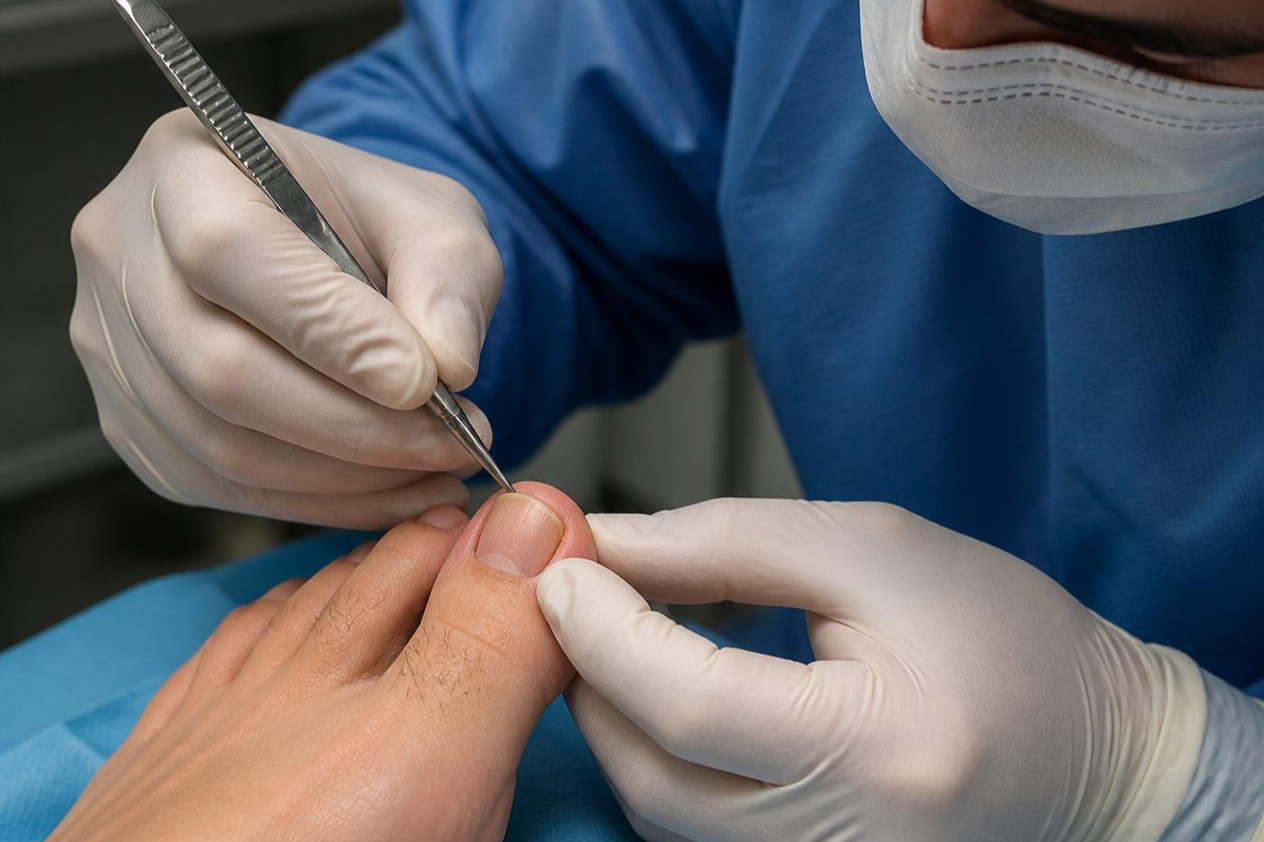
Rather than accepting that downtime as inevitable, we changed the instrument. Instead of a nail clipper, we use a fine, sterile No. 11 surgical blade to make a single, clean, controlled cut through the nail plate.
How it works
- The margins of the ingrown portion of the nail are carefully marked out first.
- The blade is drawn from the distal (outer) end of the nail toward the nail matrix at the base, with steady, controlled pressure — the surgeon can actually feel resistance change as the blade approaches the matrix.
- Near the base, the blade angle is adjusted slightly to reach the lateral matrix horn precisely, guided by the loss of resistance that signals the endpoint.
- The entire cut is made in a single, continuous stroke, which avoids leaving a ragged, uneven nail edge.
- The problematic section of nail is then gently lifted away from the nail bed using a nail splitter.
Because the abnormal, ingrown nail plate itself provides a clear visual landmark, this precise cutting approach removes exactly the problem tissue — without unnecessarily removing extra healthy nail margin.
Why This Makes a Real Difference
Compared with clipper-based avulsion, this blade technique causes noticeably less trauma to the surrounding nail bed, because there’s no force-driven tearing involved — just a controlled, single cut. In our experience, this translates directly into less post-operative pain and swelling, and a much shorter recovery: down to about 7 days, compared to the few weeks that’s typical with the conventional clipper technique.
There’s also a practical, everyday advantage: surgical blades are inexpensive and fully disposable, removing the need to sterilize reusable clippers between patients.
The Bottom Line
Ingrown toenails are one of the most common reasons patients come to see a dermatosurgeon, and getting the technique right matters — not just for resolving the problem, but for how quickly and comfortably patients get back on their feet. A small change in instrumentation made a meaningful difference in our patients’ recovery, and it’s now our preferred approach for Grade 2 and Grade 3 ingrown nails.
If you’re dealing with a persistently painful or infected ingrown toenail, don’t wait it out — we’d be happy to assess it and talk through the right treatment for you.