
Just tap the title below to view the full article PDF. 
porokeratosis jcas
A Rare Lip Growth That Wouldn’t Heal: How CO2 Laser Ablation Cleared a Case of Labial Porokeratosis
From the desk of Dr. Yogesh Bhingradia, Shivani Skin Care & Cosmetic Clinic, Surat
When a “Simple” Lip Lesion Turns Out to Be Something Rare
Not every growth on the lip is a cold sore, a cyst, or a harmless bump. Sometimes, what looks like a stubborn sore is actually a rare skin condition that most people — and even many doctors — have never encountered on the lips before.
At our clinic, we recently treated and published a case of labial porokeratosis, an exceptionally rare presentation of a condition called porokeratosis, occurring on the upper lip. Here’s the story of the case, what porokeratosis actually is, and how we were able to achieve a complete, scar-free resolution using CO2 laser ablation.
What Is Porokeratosis?
Porokeratosis is an uncommon skin disorder caused by abnormal keratinization — essentially, the skin’s outer layer doesn’t shed and renew the way it should. This creates raised, ring-shaped (annular) plaques with a distinctive thread-like, raised border and a slightly sunken centre.
It typically shows up on sun-exposed skin like the arms, legs, or face, and one classic subtype — porokeratosis of Mibelli — usually appears in childhood and can run in families. What almost never happens is for porokeratosis to affect the lips, mouth, palms, soles, or genitals. When it does, it’s often missed or misdiagnosed, because most clinicians simply aren’t looking for it there.
The Case: A 3-Year Journey to Diagnosis
A 50-year-old woman came to us with a raised lesion on her upper lip that had been slowly growing for three years. It wasn’t just cosmetic — the lesion:
- Gradually expanded outward
- Caused occasional pain
- Had spontaneously ulcerated a year earlier, leading to repeated bleeding
On examination, we found a well-defined, erythematous-to-skin-coloured annular plaque measuring 5 × 3 cm on the upper lip, with the characteristic thread-like margin of porokeratosis. Within it was a 1 × 1 cm ulcer with sloping edges, slough, and hemorrhagic crusting.
Because a persistent, ulcerated lip lesion always raises the question of malignancy, we performed a skin biopsy before deciding on treatment. The histopathology confirmed porokeratosis — showing hyperkeratosis, microabscess formation, thinning of the malpighian layer, and basal layer degeneration — and importantly, ruled out any cancerous change.
The Treatment: CO2 Laser Ablation
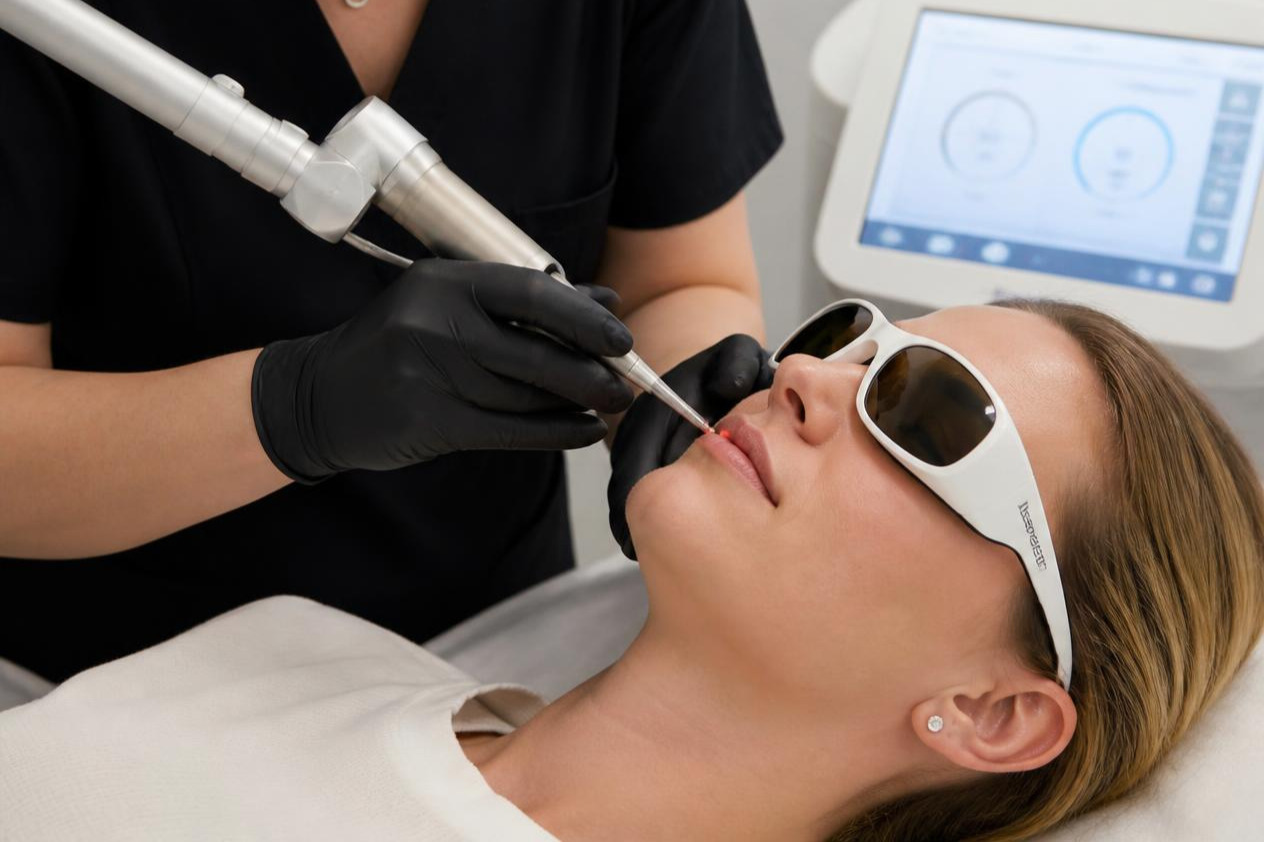
Once malignancy was excluded, we moved forward with CO2 laser ablation, using a 30W CO2 laser in continuous mode at 4W power, delivered over two sessions spaced one month apart.
Post-procedure, healing took about two weeks each time, supported by antibiotics and anti-inflammatory medication to manage the healing skin and prevent infection.
The results were excellent:
- Complete resolution of the lesion after the second session
- No recurrence over a 9-month follow-up period
- A strong cosmetic outcome, with the lip healing cleanly
Why This Case Matters
Labial porokeratosis is so rare that only a handful of cases have ever been documented in medical literature. Most published treatment approaches for porokeratosis elsewhere on the body — topical agents like 5-fluorouracil or imiquimod, cryotherapy, photodynamic therapy, dermabrasion, or surgical excision — carry trade-offs in scarring, downtime, or incomplete clearance, especially in a cosmetically sensitive area like the lip.
This case adds to the small but growing body of evidence that CO2 laser ablation is a safe, effective, and cosmetically favourable option for treating porokeratosis even in delicate, high-visibility areas such as the lips — a finding we were pleased to share with the dermatology community through publication in the Journal of Cutaneous and Aesthetic Surgery.
The Takeaway for Patients
If you notice a lip lesion that:
- Has a raised, ring-like or thread-like border
- Is slowly growing over months or years
- Won’t heal, or keeps ulcerating and bleeding
…it’s worth getting it examined and, if needed, biopsied — rather than assuming it’s a routine sore. Early, accurate diagnosis makes a world of difference in both treatment success and cosmetic outcome.