
Just tap the title below to view the full article PDF. ⬇️
plantar wart excision article pdf
Large, Painful Corn on Your Foot That Won’t Go Away? Here’s a Surgical Fix That Actually Lasts
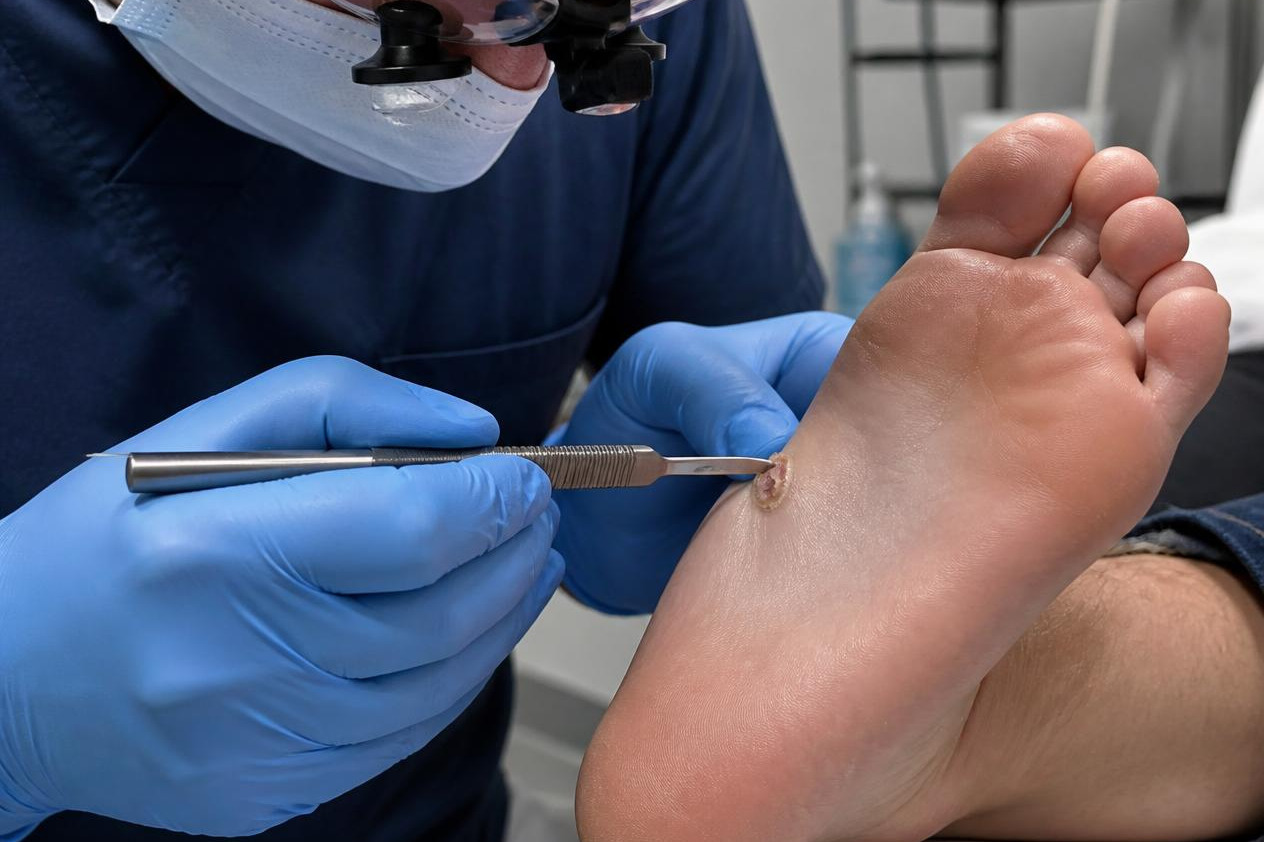
A corn on the sole of the foot might sound like a minor annoyance, but anyone who’s had a large one knows better — every single step can bring a sharp, localized pain that makes walking genuinely difficult. Creams, pads, and filing can help with small corns, but for larger ones, those measures often just aren’t enough. At Shivani Skin Care & Cosmetic Clinic, we’ve had strong, lasting results treating large plantar corns with a straightforward surgical technique, which we recently described in the Journal of Cutaneous and Aesthetic Surgery.
What Exactly Is a Plantar Corn?
A plantar corn (also called a heloma) is your skin’s protective response to repeated pressure and friction on the sole of the foot. In an effort to prevent the skin from breaking down, the body builds up a dense, cone-shaped wedge of thickened, hardened skin — usually right over a bony prominence, like near the joints of the metatarsal bones. That wedge of hard tissue then presses down into the softer tissue and nerves beneath it every time you put weight on your foot, which is exactly why corns can be so disproportionately painful for their size.
Why Small Treatments Don’t Always Work for Large Corns
For smaller corns, conservative options like careful paring with a scalpel, keratolytic (skin-softening) creams containing salicylic acid, or punch excision can work well. But once a corn grows past a certain size — generally 4mm or more across — these approaches tend to fall short. Paring only removes the surface layer and doesn’t address the deeper, wedge-shaped core, so the corn typically returns. Punch excision, while more definitive, can still leave behind some of the surrounding thickened skin (callosity), which increases the chance of recurrence.
Our Approach: Elliptical Excision
For larger corns, we use a more complete surgical technique: elliptical excision. Rather than removing just a small, round plug of tissue, we excise the entire corn — plus the hard, thickened skin surrounding it — in one connected, oval-shaped piece.
How the procedure works
- Anesthesia — the area around the corn is numbed with a local anesthetic injection.
- Marking — the widest diameter of the corn is measured, and an elliptical outline is marked around it, extending slightly beyond the corn’s visible borders to capture the surrounding callosity.
- Excision — using a fine surgical blade, the corn is excised as a single piece, down to an appropriate depth, removing the entire hyperkeratotic wedge along with the tissue around it.
- Closure — the wound is closed with simple stitches, and a pressure-relieving dressing is applied.
- Recovery — patients are advised to avoid putting weight on the treated foot for a period afterward, with stitches typically removed around day 10.
- Follow-up — patients are checked at regular intervals over the following weeks to confirm healing and watch for any recurrence.
What Results Look Like
In our experience, patients treated this way healed completely within about four weeks, with no recurrence at follow-up. A small number needed a brief touch-up — light paring of some residual callus alongside a short course of salicylic acid cream — but the corn itself did not return. Patients consistently reported significant pain relief and a real improvement in how easily they could walk and move.
Why Removing the Whole Corn Matters
The key advantage of elliptical excision is completeness. Because the entire hyperkeratotic wedge is removed — not just its visible tip — the risk of the corn simply regrowing from leftover tissue is much lower. Removing the surrounding callosity at the same time also allows the two skin edges to come together and heal more cleanly, which supports a better overall outcome.
It’s worth noting that this is a surgical procedure requiring real technical skill, and it’s specifically suited to larger corns — it isn’t necessary, or appropriate, for small ones that respond well to simpler measures. Patients also need to genuinely commit to staying off the treated foot until sutures are removed, to give the wound the best chance to heal cleanly.
The Takeaway
If you’ve been living with a large, painful corn that keeps coming back no matter how often you pare it down or how many cushioned pads you try, it may be time to consider a more definitive surgical solution. Elliptical excision offers a genuinely durable fix — and for many patients, real relief from pain they’d assumed was just something to live with.