
Just tap the title below to view the full article PDF. ⬇️
erbium glass laser for keloid treatment article pdf
A Smarter Way to Treat Keloids: Combining Laser and Steroid Injections
If you’ve ever tried to treat a keloid, you already know how stubborn they can be. These raised, thickened scars — which grow beyond the boundaries of the original wound — are notoriously resistant to treatment, and the standard approach, steroid injections alone, doesn’t always deliver the results patients hope for. At Shivani Skin Care & Cosmetic Clinic, we studied a combined approach using erbium glass laser alongside steroid injections, and our results, based on 44 patients, were recently published in the Journal of Cutaneous and Aesthetic Surgery.
Why Keloids Are So Hard to Treat
A keloid forms when the skin’s normal wound-healing process goes into overdrive — instead of stopping once the wound has closed, the tissue keeps producing collagen, growing beyond the original injury site into a firm, raised scar that can be itchy, tender, and cosmetically distressing. They’re most common on the chest, earlobes, shoulders, and back, and they have a well-earned reputation for coming back even after treatment.
Steroid injections (intralesional steroids) have long been considered the gold-standard treatment. The problem is a practical one: keloid tissue is hard and thick, which makes it genuinely difficult to inject evenly. Steroid can end up pooling unevenly or leaking out of the tissue rather than penetrating it properly — which limits how effective each injection really is, and often means needing many repeat sessions.
Our Approach: Laser First, Then Steroid, Same Sitting
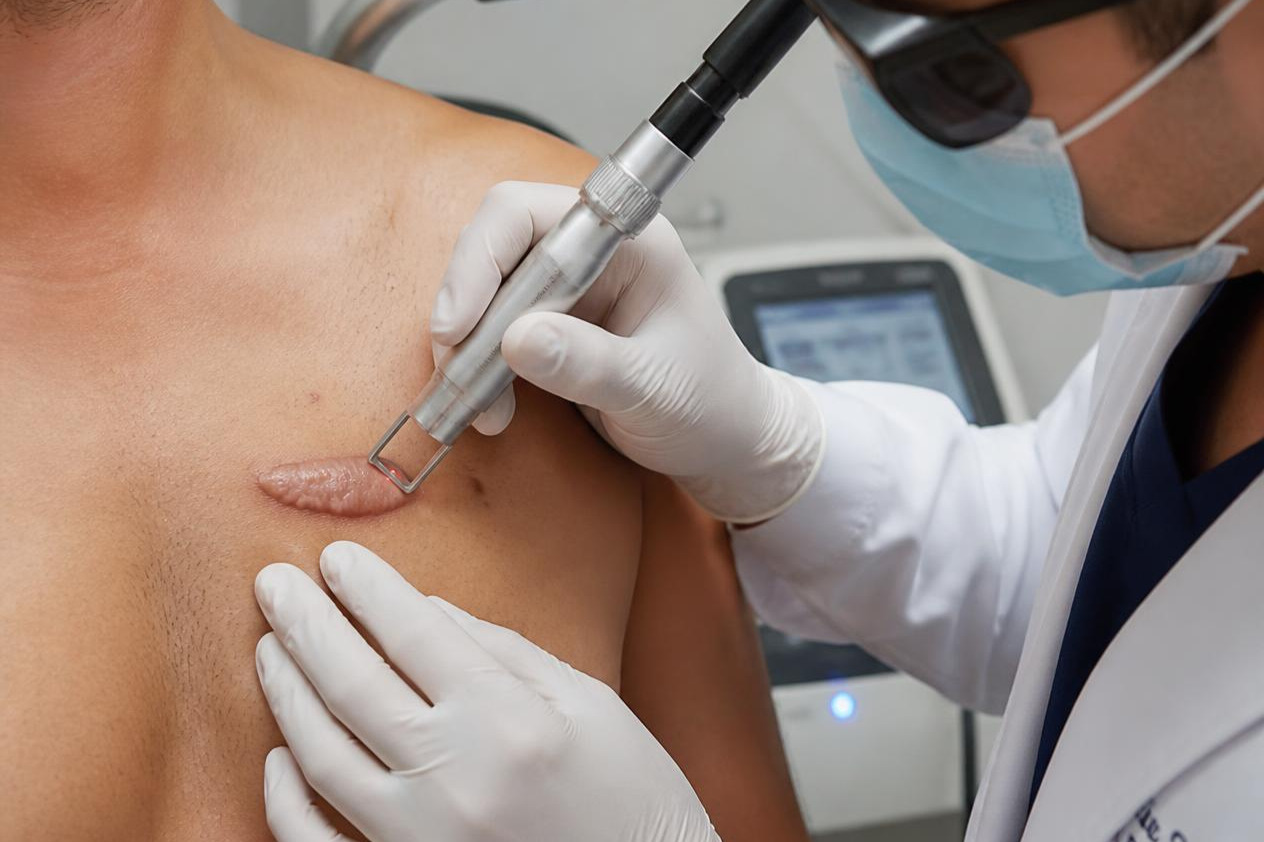
Rather than relying on steroid injections alone, we combined them with a single pass of erbium glass laser immediately beforehand, in the very same visit. This isn’t a random pairing — the laser does something specific that makes the steroid injection work better.
Erbium glass laser is a non-ablative laser, meaning it works beneath the skin’s surface without removing the top layer. It creates thousands of tiny, controlled zones of thermal injury in the deeper tissue, leaving the surrounding skin intact. This does two useful things at once: it begins softening and remodeling the dense, fibrous keloid tissue, and it creates microscopic channels that allow the steroid injected right afterward to spread through the tissue far more evenly — with less spillage, less pain, and often a lower dose needed per session.
What the treatment protocol looked like
- A single pass of erbium glass laser is applied across the keloid, without overlapping the treatment zones.
- Immediately afterward, a steroid solution is injected directly into the lesion, now able to diffuse through the laser-softened tissue much more evenly.
- This is repeated as a course of six sessions, spaced about a month apart.
- Progress is tracked using a standardized scar-severity scale, with a final assessment six months after the last session.
What We Found
Across the patients who completed the full course of treatment, keloid severity scores dropped substantially and consistently — improving from an average “moderate-to-severe” rating at the start down to a “mild” rating by the sixth session, with the greatest gains typically seen in the first three sessions. Patients also reported meaningful relief from pain and itching, two of the most bothersome day-to-day symptoms of keloids.
Just as importantly, on follow-up six months after treatment ended, the vast majority of patients showed no recurrence — a real point of difference, since keloids are notorious for returning even after they initially appear to respond to treatment. Side effects were generally mild and temporary, most commonly a brief burning sensation or some discomfort right after treatment.
Why the Combination Works Better Than Either Treatment Alone
The reasoning behind this approach reflects what we now understand about how keloids form: multiple processes — ongoing inflammation, overactive collagen-producing cells, and excess connective tissue deposition — all drive keloid growth simultaneously. Treating with steroids alone addresses inflammation, but the laser step tackles the physical density of the scar tissue itself and improves how well the steroid can actually reach and work within it. Together, they appear to interrupt more of that cycle than either approach manages on its own — which likely explains both the faster improvement and the lower recurrence we observed.
Who This Is Suitable For
This combined approach is especially useful for keloids that have been resistant to steroid injections alone, or for larger, more established keloids where achieving even steroid distribution has traditionally been a challenge. It’s also well tolerated across darker skin tones, since erbium glass laser targets water in the tissue rather than pigment, making it a safer non-ablative option for patients who might be more prone to pigment changes with other laser types.
The Takeaway
Keloids don’t have a single perfect treatment, but combining tools that address different parts of the problem is proving to be a more effective strategy than relying on any one approach alone. If you’ve tried steroid injections before without lasting success, this combination technique may be worth discussing